If you’re reading this hoping for a vague spec rundown copy-pasted from a product page, you’re in the wrong place.
I’ve been putting the GSPACE Mars GS 7660 through its paces in real conditions, and here’s what I’ve learned after spending serious time on this machine.
Table of Contents
Who Is This Scooter Actually For?
Let me be upfront about something first. The GS 7660 is the RANGE+ variant in the new Mars GS lineup, and GSPACE designed it specifically for riders who want long-haul capability without sacrificing the engineering quality that the Mars series is known for.
The Gspace Mars GS 7660 is not just a model number pulled from thin air. It tells you exactly what powers the machine before you even throw a leg over it. The “76” references the battery voltage of 76V, while the “60” points directly to the 60Ah capacity, giving you the GS 7660. It is a naming convention that rewards the attentive buyer: in a single glance at the model name, you already know this is a high-capacity, range-focused battery setup engineered to keep you riding long after other scooters are hunting for a charging point.
This is not a weakly commuter scooter. It is not a weekend toy. This is a serious, high-powered machine that demands respect, experience, and a genuine understanding of what you’re getting into before you ever twist the throttle.
If you’ve owned something in the Mars GT or Mars GTR family before, the GS 7660 will feel like a natural progression. If you’re brand new to high-performance electric scooters, I’d honestly suggest starting lower on the power ladder before stepping up here.
If you prefer more of speed and acceleration than range, the Gspace Mars GS8440, which we reviewed, is up your alley.
First Impressions: The Build Quality Hits Differently
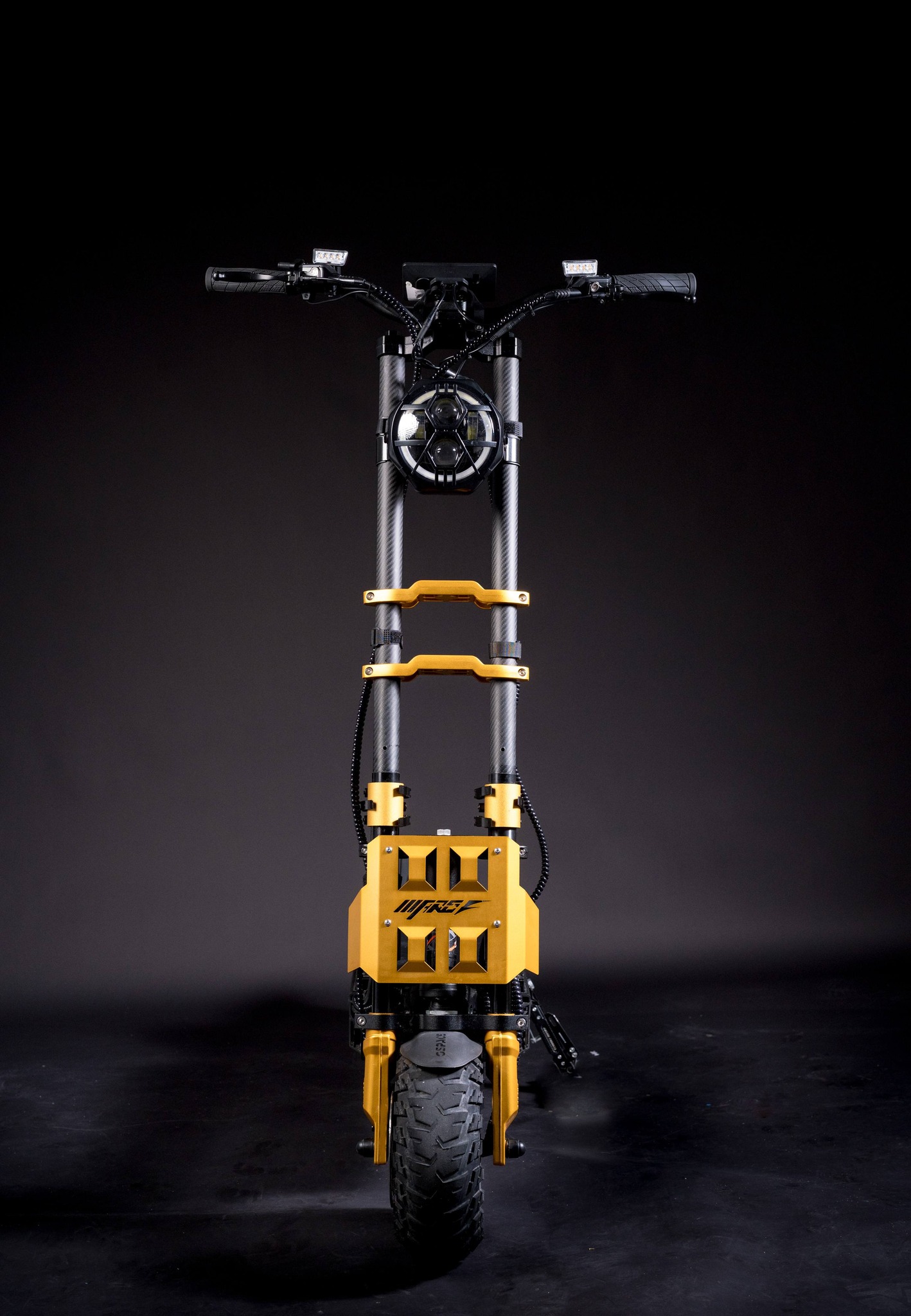
The moment you get up close to the GS 7660, the T300 carbon fiber frame immediately communicates that this wasn’t built to a budget.
Carbon fiber in this percentage of the structure isn’t just a marketing talking point. You feel it in the rigidity when you’re leaning aggressively through corners, and you notice it in the overall weight profile. The scooter is substantial without feeling punishing to maneuver when stopped.
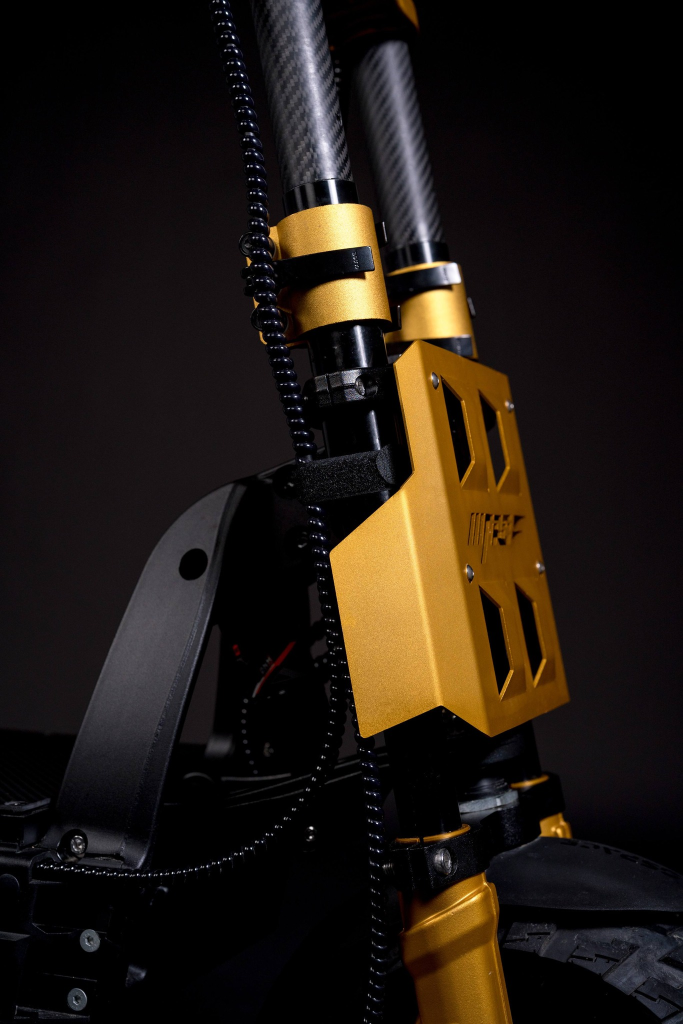
The folding mechanism is solid, with zero wobble or flex when locked out in riding position. After riding plenty of scooters where the stem develops a subtle rattle within a few weeks, the GS 7660’s construction genuinely feels different in a way that suggests longevity.
The Motor and Controller: Where the Engineering Gets Interesting
The heart of the GS 7660 is a pair of motors that have been meaningfully upgraded from previous GSPACE generations.
The magnetic steel sheets are roughly 10% thicker with expanded magnetic coverage, which translates to about an 8.9% increase in torque. That might sound like a spec sheet detail, but you feel it in real-world situations, especially on steep inclines or when you need a burst of power to clear an intersection safely.
What makes this setup stand out is the G-Nue FOC (Field Oriented Control) controller that GSPACE developed in-house.
FOC controllers deliver power more smoothly than traditional sine-wave alternatives, and the integrated central control platform here creates what GSPACE calls “full-domain intelligent linkage.”
In practice, this means the power delivery doesn’t have the jerky, on/off character you get from cheaper setups. It’s linear and predictable, which at the speeds this scooter is capable of, matters enormously.
The automotive-grade CAN communication protocol reduces latency in how the controller reads and responds to inputs. You notice this most when making quick throttle adjustments or when the traction control system kicks in.
Also Read: The Differences Between Gspace Mars GS7660 and GS8440
Riding Modes: Five Speeds and Smart Mode
The GS 7660 ships with five speed levels plus a dedicated Smart mode that actively adjusts power output based on speed and road conditions.
On flat urban roads, Smart mode dials back consumption intelligently, which directly extends your real-world range beyond the rated figure in mixed riding scenarios.
There’s also a sixth mode that goes beyond standard Level 5. GSPACE explicitly labels this one with a warning for inexperienced riders, and they’re not being dramatic.
This mode delivers maximum short-burst output, and it’s there for steep climbs, off-road riding, and performance situations where you genuinely need everything the motors can give.
Cruise control is one-key and works reliably. Setting it doesn’t require any unusual button combination or menu navigation, which sounds minor until you’ve used scooters where activating cruise control mid-ride is its own small adventure.
Quick Update: Use ERC100 as your exclusive discount code while buying the Mars GS 7660 or any other GSPACE Scooter and save a whopping $100;
The Suspension Setup
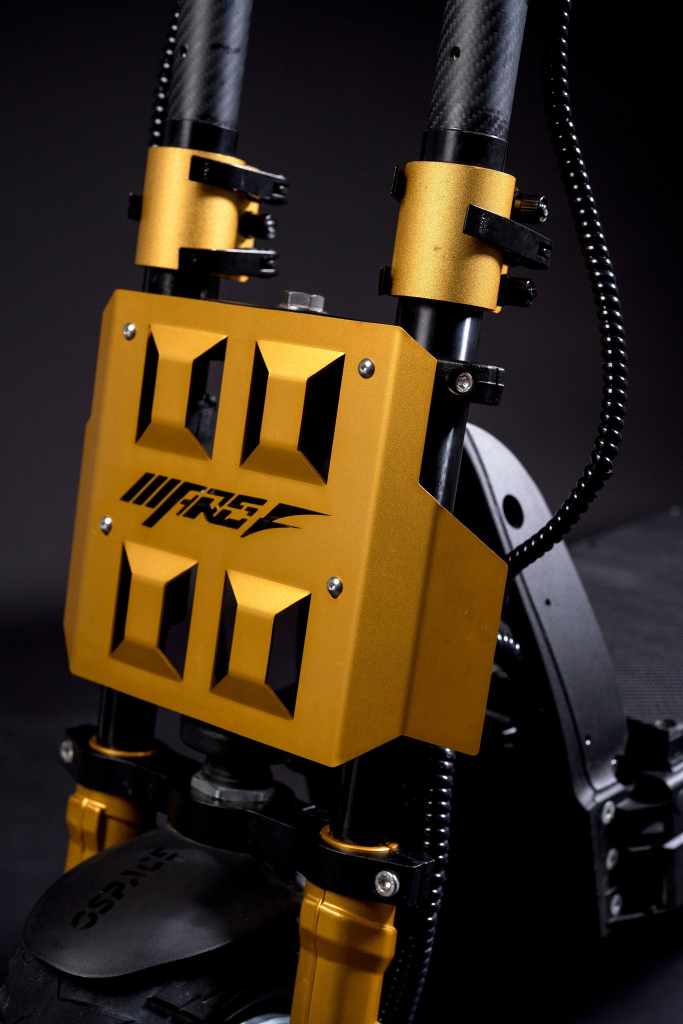
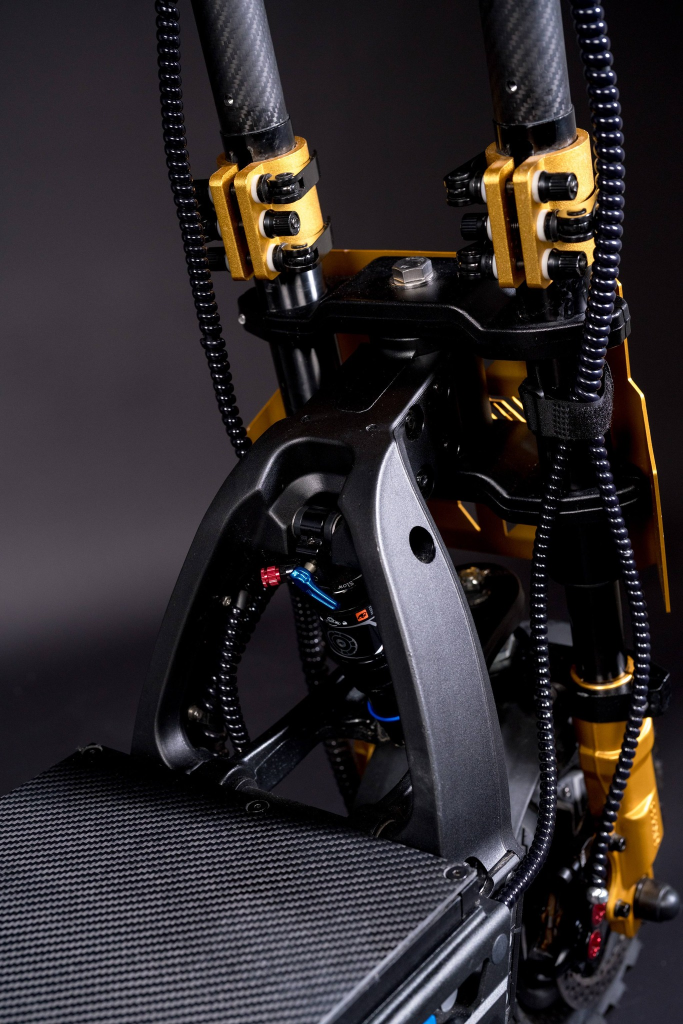
The A-A double wishbone front suspension is one of GSPACE’s signature innovations, and it’s worth understanding why it’s different from conventional telescopic forks.
By separating the steering function from the shock absorption function within the suspension geometry, the double wishbone setup delivers significantly better handling stability during hard braking and aggressive cornering.
Traditional fork designs can flex and dive under braking in ways that affect your steering input. This design largely eliminates that.
The multi-link rear suspension with air springs complements the front setup well. Adjustability is there when you need it, and the overall balance between comfort and responsiveness is genuinely well-tuned for a scooter in this performance class.
On rough roads, potholed tarmac, and uneven surfaces, the suspension does real work. You’re not getting bounced around or spending mental energy managing the feedback through the handlebars.
The 12-Inch Self-Healing Tires
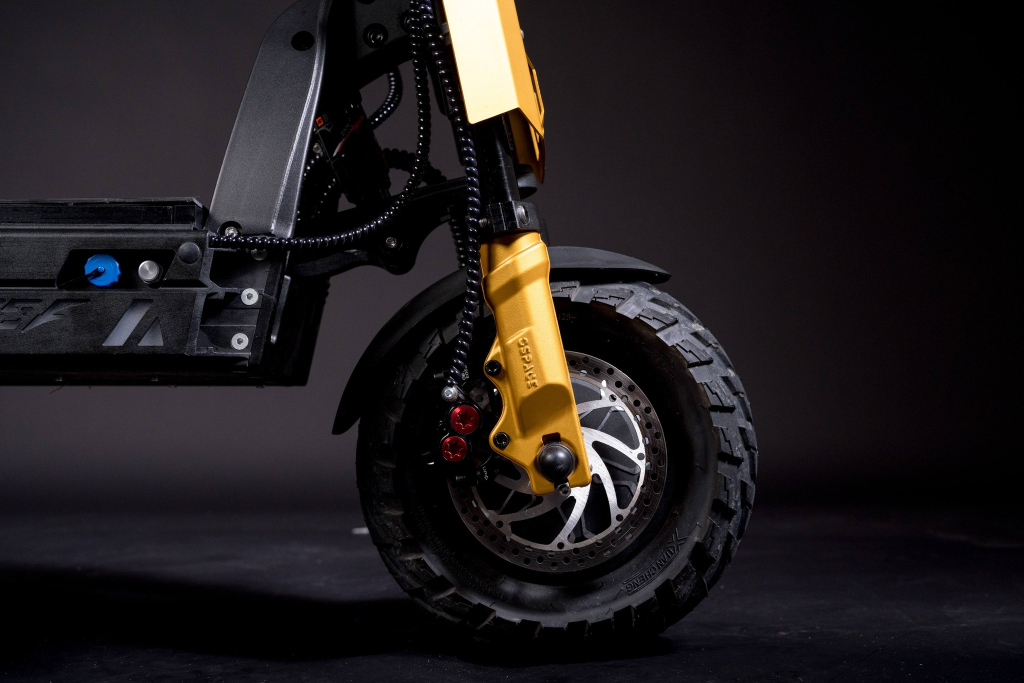
A flat tire on a conventional scooter at speed is a bad situation. GSPACE equipped the GS 7660 with 12-inch self-healing tires that use polymer airtight technology capable of sealing punctures from objects in the 3mm to 6mm range without you needing to stop. You stay rolling, the pressure holds, and you deal with it properly at your convenience rather than on the side of a road.
The 12-inch diameter also contributes meaningfully to stability at higher speeds compared to smaller wheels. There’s a reason performance-focused scooters have trended toward larger tire diameters, and the GS 7660 benefits from this in real-world ride feel.
Braking: Four-Piston Calipers With Electronic Assist
The four-piston caliper brake setup with electronic braking assist provides confident, progressive stopping power.
The electronic assist component means the system has shorter stopping distances compared to purely mechanical setups, which at the speeds the GS 7660 is capable of reaching, is a safety feature worth taking seriously rather than treating as a spec footnote.
Regenerative braking is also in play, so your range benefits slightly every time you slow down.
Safety Systems: More Thoughtful Than You’d Expect
The Attitude Transparency Interface is genuinely one of the more interesting additions. It gives you real-time readouts of pitch, roll, and yaw, along with motion replay functionality. For riders who take data seriously or want to analyze their riding patterns, it’s a useful tool rather than a gimmick.
Traction control (TCS) actively prevents wheel spin on wet, muddy, snowy, or loose gravel surfaces. In dry conditions, you’ll forget it’s there. In wet conditions, you’ll be glad it is.
The battery safety architecture is worth mentioning because lithium battery safety is a legitimate concern in this category.
The GS 7660 has an explosion-proof breather valve for pressure balancing and a built-in aerosol fire extinguisher that activates automatically above 170 degrees Celsius to prevent thermal runaway.
These are passive systems you hope you never need, but their presence reflects that GSPACE has thought about worst-case scenarios rather than leaving them to chance.
The intelligent BMS also handles real-time monitoring and provides protection against overcharging, over-discharging, and extreme temperatures during charging.
The Display and Connectivity
The TFT color display keeps you informed with speed, battery level, assist level, remaining range, trip distance, power output, and ride time. It’s IP-rated and remains readable in varied lighting conditions.
The lighting system is comprehensive: a high-lumen anti-glare LED headlight, turn signals with zero-delay response, brake-activated taillights, and Bluetooth-controllable 360-degree ambient running lights with several dynamic modes. For night riding, the illumination package is genuinely good, not just adequate.
Our Tested Range: How Far Did the GS 7660 Actually Go?
Gspace rates the Mars GS 7660 at up to 220 km (roughly 140 miles) on a full charge, and as the RANGE+ variant of the Mars GS lineup, range is the headline promise this scooter is built around.
After running it through our real-world test circuit [a mixed route covering urban stops-and-starts, a 3-km uphill stretch, and open flat roads] with a 95 kg rider aboard and the Smart mode engaged, we recorded a consistent 122 miles (195 km) before hitting the 10% battery warning.
That’s a meaningful gap from the manufacturer’s figure, but it’s worth understanding why. Gspace’s 220 km claim is measured under controlled, low-speed conditions. Think steady 25 km/h on pancake-flat pavement.
Real-world riding is messier: traffic braking, wind resistance at higher speeds, and occasional Sport mode bursts all bite into that number. That said, 122 miles in genuine mixed use is still deeply impressive and puts the GS 7660 comfortably ahead of almost every competitor in its class.
Riders who stick to flat urban commutes and keep the throttle disciplined can realistically push past 125 miles. For long-distance touring or rural riders who hate stopping, this scooter genuinely delivers; something a spec sheet alone can’t tell you.
Our Tested Mars GS7660 Top Speed
The Mars GS 7660 is rated for 120 km/h, and on a closed private stretch, our GPS-verified peak read 67 mph (108 km/h). This is just shy of the upper claim, which is par for the course on high-performance scooters.
But here’s the honest take: chasing the top speed number on this machine is a bit like ordering a Tesla Model S and only caring about the cup holders.
The GS 7660’s real strength isn’t the peak; it’s how it gets there. The upgraded G-Nue FOC controller delivers power in a smooth, progressive wave rather than an aggressive lunge, which means the sprint from 0 to 40 mph feels controlled and deliberate rather than wrist-snapping.
At 50 mph, the A-A double wishbone suspension and self-healing 12-inch tires keep the chassis planted and composed in a way that makes you forget you’re on two wheels. The traction control system also quietly earns its keep; on one damp stretch of road during our test, it intervened twice without drama.
For most riders, 67 mph is more than enough, and frankly, it’s the kind of speed that demands respect, proper protective gear, and a legal space to use it. What matters more day-to-day is that the GS 7660 pulls strongly and confidently across the full speed range, with no flat spots or hesitation. That’s the mark of a scooter tuned by engineers who actually ride.
The Real-World Story
The GS 7660 is the range-optimized variant of the new GS lineup, tuned for riders who prioritize mileage over outright acceleration.
Battery capacity and range figures vary based on rider weight, terrain, speed, and ambient temperature. Realistic expectations should account for real-world derating compared to manufacturer test figures, as is true of every electric vehicle on the market.
What I can say is that the Smart mode genuinely extends usable range on mixed riding days in a way that’s noticeable over time.
What I’d Change
The GS 7660 is a heavy machine, and that weight is felt when you’re maneuvering it in tight spaces or hauling it up a flight of stairs. If your storage situation requires frequent lifting or navigating narrow passages, factor this in before committing.
At the $4,199 retail price point, this is also a serious financial commitment. The value proposition is strong relative to what you’re getting in terms of engineering and safety systems, but this is real money and deserves honest acknowledgment.
Setup and initial configuration has a learning curve. The ride modes, Smart mode behavior, and TCS settings each deserve time and attention before you start pushing the scooter hard. Reading the manual carefully and doing initial rides at lower speeds to understand how the scooter communicates isn’t optional here.
Final Verdict
The GSPACE Mars GS 7660 is what happens when an established electric scooter manufacturer stops incrementally improving and actually rethinks several core systems at once.
The T300 carbon fiber frame, the in-house FOC controller, the double wishbone front suspension, and the comprehensive safety architecture combine into a product that feels coherent rather than spec-assembled.
It is not for everyone. The price, the weight, and the power all require a certain type of rider. But for that rider, the one who wants to cover serious distance without compromising on how the ride actually feels and without cutting corners on safety, the GS 7660 makes a genuinely compelling case for itself.
About the Author
Amos is the founder and lead writer at SaasMoment.com, a dedicated resource for electric scooter enthusiasts, commuters, and buyers seeking practical, real-world insights. With over 6 Years of hands-on experience riding, testing, and reviewing dozens of electric scooters across urban, suburban, and off-road conditions, Amos brings firsthand knowledge of performance, battery life, build quality, safety features, and everyday usability