I have been riding electric unicycles for several years now, and I will be honest: I did not think anything in the 20-inch performance class would genuinely surprise me in 2026.
After spending time on the Nosfet Aeon, the Leaperkim Patton-S, and a handful of other performance wheels this year, my expectations for new releases had settled into a comfortable cynicism. Then Nosfet unveiled the Xeno.
I got a chance to put the Xeno through its paces as one of the early riders to test a pre-production unit before the official preorder went live through Next Gen Mobility. As you preorder, NGM provides free Beidou Toe Hook Pads for the Xeno [valued at $120] as stock lasts.
What follows is my honest, comprehensive take on what this wheel actually feels like to ride, where it genuinely excels, and a few things worth knowing before you commit.
Quick Verdict
The Nosfet Xeno is the most impressive power-to-weight ratio I have experienced in the 20-inch EUC segment.
It hits significantly harder than anything this light has any business hitting, the RFloXa bidirectional suspension is genuinely exceptional, and Nosfet’s legendary quality control is once again fully intact.
At $2,999 from Next Gen Mobility with a late July/early August ETA, this is a compelling preorder for experienced riders who want performance without the punishing bulk of a 40+ kg machine.
Who Is Nosfet and Why Does It Matter?
Before getting into the Xeno itself, it is worth understanding who built it. Nosfet has carved out a reputation in the EUC community as one of the most reliability-obsessed manufacturers in the industry.
The Nosfet Apex and Nosfet Aero both accumulated sterling track records for fit, finish, and longevity.
Previous Nosfet models have among the lowest field-failure rates of any premium EUC brand, and that quality control pedigree is directly relevant to the Xeno because it shapes how confident you can feel about this preorder.
This is not a startup throwing specs at a wall to see what sticks. Nosfet has earned its credibility through consistent, thoughtful engineering, and the Xeno reflects that discipline.
Nosfet is undoubtedly one of the leading electric unicycle brands in 2026.
What the Nosfet Xeno Is
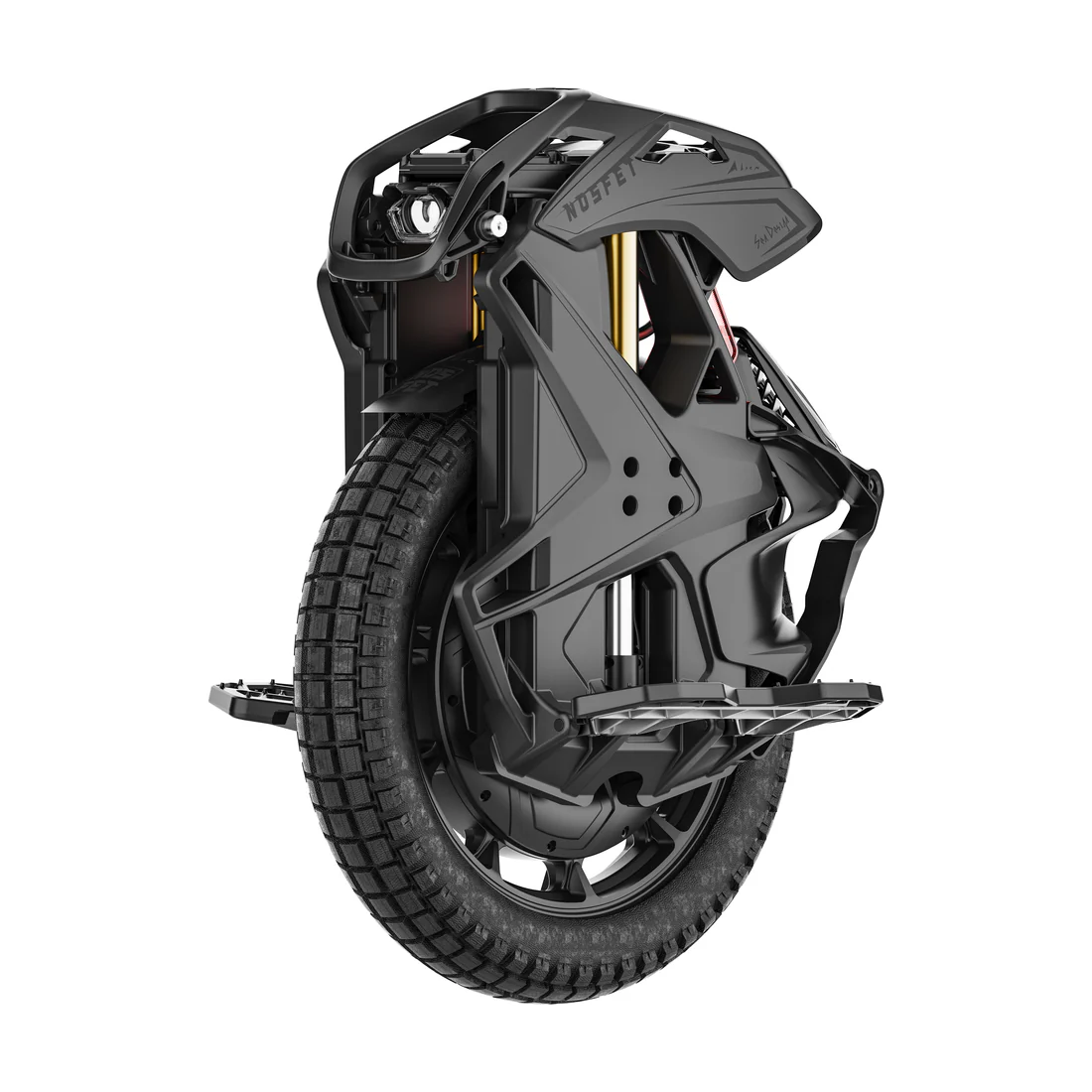
The Xeno is Nosfet’s 20-inch flagship performance EUC. It runs on a 126V system, carries a 2200Wh Samsung INR21700 50S battery pack, and is powered by a motor rated at 2500W nominal with a peak output of 10,000W.
It uses a dual-board controller architecture with 24 MOSFETs and a maximum current capacity of 495A.
The headline number that immediately catches attention is the weight: 72.7 lbs (approximately 33 kg). That is a staggering 8 lbs lighter than the Leaperkim Patton-S while producing 3,000W more peak power. Let that sink in for a moment.
Three tire options are available at preorder: off-road, street, and hybrid (the hybrid variant will ship roughly one month after the initial batch). The 80/90-14 tire measures 20 inches edge-to-edge, which is genuine 20-inch territory.
Riding the Xeno: First Impressions
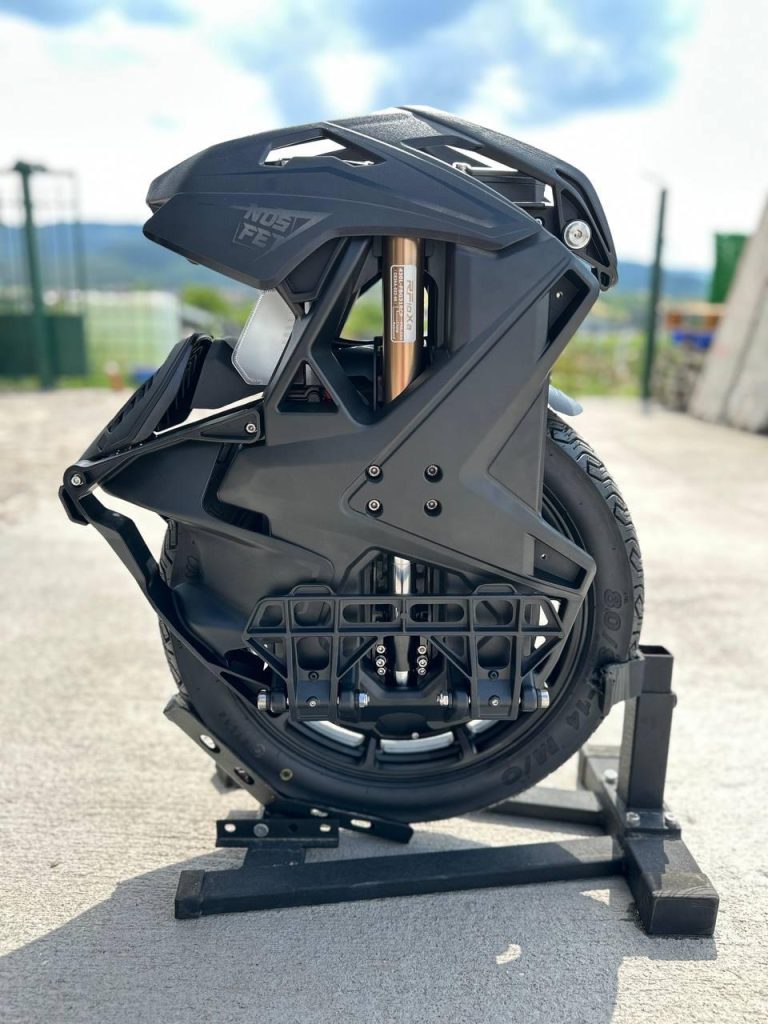
The first thing I noticed stepping onto the Xeno was how planted it felt despite the weight. The low center of gravity Nosfet engineered into the chassis was immediately perceptible.
The wheel does not feel like a 33 kg machine in motion because the mass is distributed so deliberately that your body barely has to compensate for it.
My first lean into acceleration was a genuine shock. The 10,000W peak and the dual-board architecture deliver torque that does not build progressively; it arrives.
One moment you are stationary, the next you are well past comfortable commuting speeds.
This is not a wheel for anyone still developing their balance instincts, and I will return to that point in the section on who this EUC is for.
The pedal feel is firm and responsive, exactly what you want when you are pushing hard into corners or launching up inclines.
Via the integrated display or the companion app, pedal hardness is adjustable between 0% and 100%, which gives riders a meaningful range of tuning options.
I ran it at around 65% for most of my test sessions and found that to be an excellent everyday balance between responsiveness and predictability.
Suspension: The RFloXa System in Practice
This is where the Xeno genuinely separates itself from most of the competition in its weight class.
The symmetrical bidirectional suspension uses premium RFloXa shocks on both sides of the wheel, providing 90mm of total travel.
What makes this system genuinely outstanding in practice is the full independent adjustability: compression, rebound, and preload can each be dialed in individually on each side.
Critically, compression and rebound adjustments are finger-adjustable with no tools required, which means you can tweak your setup on the trail without pulling out a kit.
I tested the Xeno across a mix of surfaces: smooth asphalt, gravel fire roads, and moderately rooted singletrack.
On pavement, the suspension disappears; the ride is so composed you could mistake it for a rigid wheel. On the trail is where it genuinely shines.
Root strikes and embedded rocks that would send a rigid wheel bucking into your ankles are absorbed with a smoothness that makes sustained high-speed trail riding feel achievable rather than nerve-wracking.
For heavier riders, Nosfet recommends increasing the bottom compression damping to prevent bottoming out during jumps or hard landings. For lighter riders or pure street commuters, backing off compression and preload provides a supple, plush ride character that makes long distances genuinely comfortable.
The adjustability range is wide enough to serve riders across a broad weight spectrum, which is a real engineering achievement. The Xeno is undoubtedly one of the best suspension EUCs.
Power and Speed: What 10,000W Peak Actually Feels Like
The top-end numbers are well-documented: the Xeno has a freespin lift speed of 95 km/h (approximately 59 mph), a maximum real-world riding speed of around 50 mph, and a sustainable riding speed of approximately 45 mph. These are serious numbers, and the motor’s behavior at high speed is what I found most impressive.
Many high-powered EUCs deliver their best torque in the lower speed range and feel increasingly strained as you push toward their limits.
The 126V architecture of the Xeno largely avoids this. Even with a partially discharged battery, the torque character remained consistent and predictable during my sessions.
That is a direct benefit of running a higher voltage system: the motor sees cleaner current at a wider range of battery states.
Climbing is almost unfairly easy. The combination of instantaneous torque delivery and the low weight means the Xeno simply does not care about inclines that would genuinely tax most competitors. Before you ask, this is an ideal wheel for commuting.
Safety Systems: Hall Sensorless Emergency Mode
One feature that deserves more attention than it typically gets in spec sheets is the hall sensorless emergency mode.
In most EUCs, if the motor’s hall sensors experience an unexpected failure or communication disruption, the result is an immediate cutout. You go from balanced riding to the ground in a fraction of a second.
The Xeno’s control architecture handles this very differently. If a hall sensor failure is detected, the motherboard transitions automatically and seamlessly to a sensorless algorithm that maintains balancing in a reduced power state.
You feel the power reduction, but the wheel keeps you upright and allows you to ride to safety rather than suffering an unannounced fall.
For experienced riders who push hard, this is a meaningful safety architecture difference. It will not prevent all incidents, but it materially reduces the risk of a particular class of failure event.
The voltage protection ladder is also worth noting: low voltage alerts begin at 91.5V, tilt-back initiates at 88.5V, and emergency BMS shut-off occurs at 85.5V.
The smart BMS inspects each individual cell string for overvoltage and over-discharge, which is the kind of granular battery management you want from a 2200Wh Samsung cell pack.
Lighting and Visibility
The 20W headlight with speed-dependent auto-brightness is one of the better lighting implementations I have seen on a production EUC.
The brightness adjusts as your speed increases, which means adequate illumination at both crawling urban speeds and high-speed trail runs. A daylight sensor also enables automatic running lights.
The multi-mode RGB taillight is fully customizable and genuinely bright. Night visibility on an EUC is often an afterthought bolted on at the end of the design process; on the Xeno it feels like something the engineers actually considered.
Build Quality and Materials
The chassis is magnesium alloy throughout, which delivers the structural rigidity you need for hard riding while keeping mass down.
The IPX6 waterproofing rating means the Xeno can handle heavy rain and genuine wet conditions without you having to worry about where you park it during a summer storm.
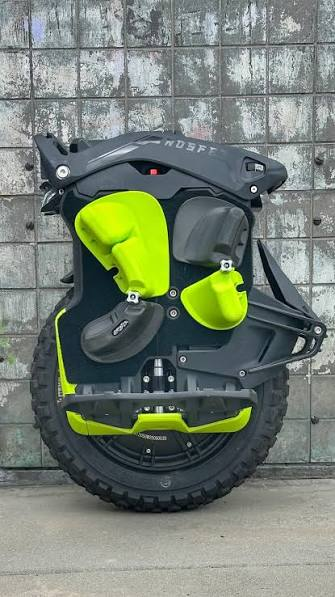
The pedals are cast lightweight units that ship with two different-sized nylon overlay options that bolt directly onto the pedal base.
This gives riders a meaningful choice of platform size and grip character, which is a thoughtful detail for a wheel aimed at riders across different disciplines.
The trolley handle locks in both the upright and stowed positions, which sounds minor but makes a real practical difference when you are navigating stairs, tight corridors, or public transit.
The fit and finish across the unit I tested was exactly what I have come to expect from Nosfet: precise, consistent, and clearly inspected before it left the facility.
Charging: What You Need to Know
The Xeno ships with a 5A charger that will bring the 2200Wh pack to full in approximately five hours. Nosfet has confirmed that maximum charging speed is 10+ amps, which means faster third-party chargers are supported, though the specific maximum has not been finalized at the time of this writing.
This is an important practical note: budget 5 hours for overnight charging with the included charger, and plan accordingly for longer touring days.
Software and Customization
The integrated display and companion app give you precise control over a surprisingly deep set of parameters.
Pedal hardness adjustment runs the full 0% to 100% range. Acceleration assist, pedal tilt, PWM tilt-back, speed tilt-back, and a side-tilt angle cutoff for extreme trail riding are all adjustable.
The side-tilt cutoff is specifically engineered for aggressive off-road use, where lean angles on switchback terrain can otherwise trigger unnecessary safety interventions.
The level of software control available on the Xeno is closer to what you typically find on purpose-built trail machines. The fact that Nosfet has packaged it into a wheel that is equally comfortable on a daily commute says a lot about the engineering philosophy behind this product.
Nosfet Xeno vs Leaperkim Patton-S: How They Compare
The Patton-S is the wheel most riders in this segment will be cross-shopping, so it is worth being direct about where the Xeno stands.
The Xeno is approximately 8 lbs lighter. It produces 3,000W more peak power. Its bidirectional suspension system offers comparable travel (90mm) with arguably more refined adjustability. The dual-board architecture and 495A max current capacity represent a meaningful step up in controller capability.
The Patton-S has a longer track record with a larger existing user base, which means more community knowledge, more accessory options, and more established riding data. For riders who value that ecosystem, that is a legitimate consideration.
For riders who are primarily motivated by the best power-to-weight ratio currently available in a 20-inch wheel, the Xeno makes a compelling case.
Who Should Buy the Nosfet Xeno
The Xeno is emphatically not a beginner’s wheel. The torque response, the high-voltage architecture, and the real-world top speed require solid, established balance and body-control instincts.
If you are still developing your riding foundation, the Xeno’s power delivery will be more dangerous than exhilarating. Consider the Aero as your perfect beginner wheel.
For experienced riders, the Xeno is best suited to someone who does a mix of demanding trail riding and regular commuting, wants genuine performance capability without the physical burden of a 40+ kg machine, values Nosfet’s proven reliability track record, and is comfortable with the responsiveness that comes from a high-power, lower-weight platform.
It is also an excellent choice for riders coming from a 100V platform who want to understand what a higher-voltage torque character feels like in a package that does not require a dedicated vehicle to transport.
What the EUC Community Is Saying About the Xeno
The Xeno’s debut has generated significant discussion across the EUC community, and the reaction has been almost uniformly enthusiastic.
The thread on the Electric Unicycle Forum (electricunicycle.org) accumulated 117 replies within days of the announcement, a response pace that reflects genuine excitement rather than casual interest.
The conversations I have seen across Reddit’s r/ElectricUnicycle, the EUC Forum, and the Next Gen Mobility Telegram group reveal a consistent set of themes. Riders with experience on the Patton-S are particularly vocal about the weight difference being meaningful in practice, not just on a spec sheet.
Several riders with trail-focused riding styles noted that the bidirectional RFloXa suspension system is a significant upgrade over what most wheels in this class offer.
The hall sensorless emergency mode is generating specific discussion among safety-conscious riders, particularly those who have had or know riders who have experienced hall sensor failures on other platforms.
The preorder price of $2,999 has been received positively relative to the specifications. Multiple community members have noted that the Xeno slots in at a price point where the specifications are genuinely difficult to match from competing platforms.
Some riders have noted that they appreciate that the wheel’s profile makes it accessible to a wider range of performance tiers than a pure speed machine would.
The adjustable pedal hardness and suspension tuning mean the Xeno can be softened for early adaptation sessions, then progressively dialed up as confidence grows.
One recurrent point from more skeptical community members is the standard caution about preordering any new model: wait for real-world delivery units to confirm that production specifications match the pre-release units.
This is legitimate, measured advice. What I would add from my own time on the unit is that the engineering philosophy and construction quality I experienced were consistent with what Nosfet has delivered on every previous release. The Xeno is not a first-time model from a brand that is still finding its feet.
Should You Preorder the Nosfet Xeno?
If you are an experienced rider considering this wheel, I want to speak directly to the question of preorder confidence.
Nosfet’s track record on both the Apex and the Aero was consistently strong. Their quality control standards are among the most rigorous in the industry, and both previous models shipped to customers in conditions that closely matched the specifications their communities were anticipating.
The Xeno is not a speculative bet from an unproven brand; it is the next product in a documented lineage of reliable, well-engineered wheels.
Next Gen Mobility, the retailer handling this preorder, carries a 4.9-star average rating on Trustpilot and has a strong community reputation among North American EUC riders.
The ETA of late July/early August 2026 is reasonable for a wheel that is already in pre-production testing. The preorder price is $2,999, and the three tire variants give you meaningful choice about how you plan to primarily use the wheel.
If you are certain about the off-road or street configuration, those variants are available now. If you want the hybrid tire, that shipment is expected approximately one month after the first batch arrives.
For experienced EUC riders who have been looking for a 20-inch performance wheel that does not force them to choose between raw capability and manageable weight, this is genuinely the most compelling preorder I have seen in this segment in a long time. Go ahead and secure your spot with confidence.
Full Specifications at a Glance
| Specification | Details |
|---|---|
| Motor | 2500W Nominal / 10,000W Peak |
| Voltage | 126V |
| Battery | 2200Wh, Samsung INR21700 50S |
| Our Tested Top Speed | 48 mph |
| Sustainable Speed | 42 mph |
| Freespin Lift Speed | 95 km/h (~59 mph) |
| Tire Size | 80/90-14 (20 inches edge-to-edge) |
| Tire Options | Off-road, Street, Hybrid |
| Suspension | Symmetrical Bidirectional Coil/Oil (RFloXa) |
| Suspension Travel | 90mm |
| Controller | Dual-board, 24 MOSFETs, 495A max |
| Headlight | 20W, Auto-Brightness, Daylight Running |
| Taillight | Multi-mode RGB |
| Included Charger | 5A (~5 hours) |
| Max Charge Rate | 10+ amps confirmed |
| Waterproofing | IPX6 |
| Trolley Handle | Yes (locking) |
| Weight | 72.7 lbs (33 kg) |
| Dimensions | 925mm x 283mm x 545mm |
| Price | $2,999 USD |
| ETA | Late July/Early August 2026 |
Final Score
Performance: 9.5/10 The 10,000W peak in a 33 kg package is genuinely unprecedented in this wheel class. The torque delivery is immediate and relentless.
Suspension: 9.3/10 The RFloXa bidirectional system with finger-adjustable compression and rebound is among the best implementation of adjustable suspension I have ridden on a production EUC.
Build Quality: 9.7/10 Magnesium alloy chassis, IPX6 waterproofing, and Nosfet’s trademark quality control standards are all present.
Safety Systems: 9.3/10 Hall sensorless emergency mode is a meaningful differentiator. The BMS architecture is thorough and intelligently designed.
Value: 8.9/10 At $2,999 the Xeno is priced competitively for the specifications it delivers. Experienced riders will find it justifiable. Newer riders should not be here yet.
Overall: 9.5/10
The Nosfet Xeno is the most capable power-to-weight performance EUC I have tested in the 20-inch class. It carries Nosfet’s reliability DNA, genuine engineering substance behind every key feature, and a preorder opportunity that I believe experienced riders should take seriously.
Sam handles our Electric Unicycle segment. He has been riding EUCs since 2019 and recently decided to start writing about them. He aims to keep the EUC industry growing in the safest way possible.