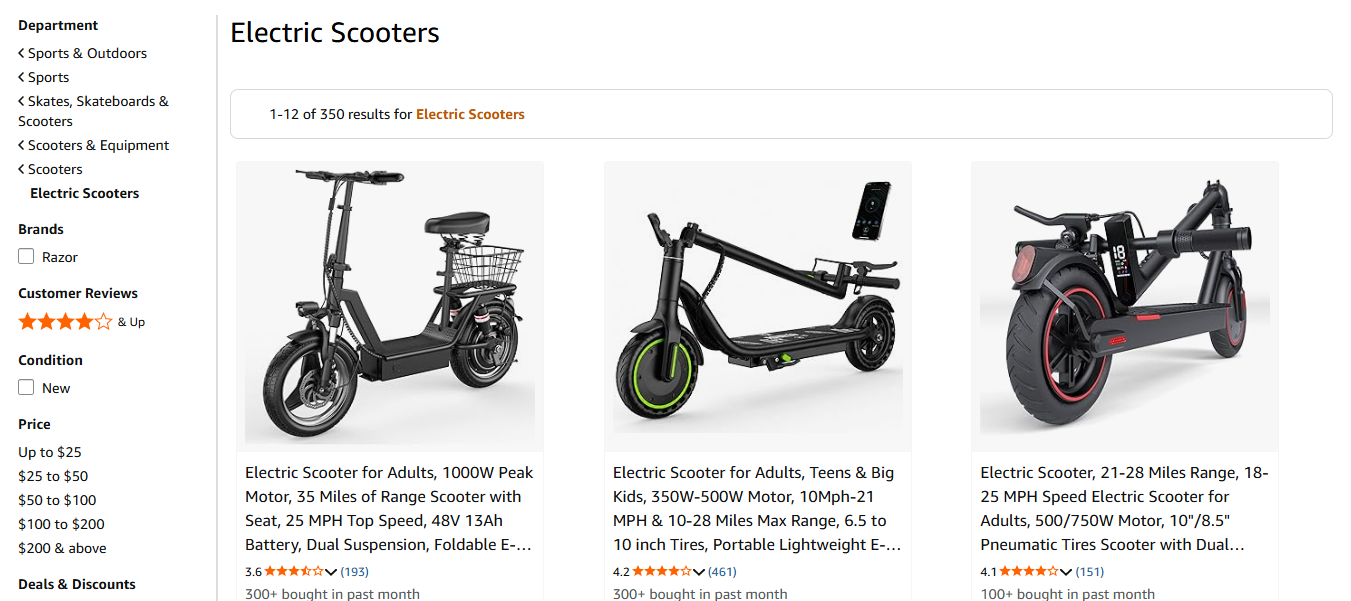
Every week, new riders arrive in electric scooter forums asking for help with a scooter they just bought on Amazon. The community’s response is almost always the same: you should have bought from the manufacturer or a specialist dealer. Here is the full picture of why.
The pattern is remarkably consistent across Reddit’s r/ElectricScooters, Facebook communities like the Electric Scooter Guide group, and Discord servers for brands such as Kaabo, Apollo, and VSETT.
A new rider shows up with a problem. The community diagnoses it quickly. Then comes the unavoidable question: where did you buy it? And when the answer is Amazon, the mood in the thread shifts. To begin with, a social user thought they were receiving their favorite scooter, only to have two bags of dirt delivered to them!
This is not tribalism or brand snobbery. It is the accumulated wisdom of thousands of riders who have watched the same scenarios play out over and over again.
The problems with buying a performance electric scooter from Amazon are structural, documented, and increasingly serious.

The fire problem is getting worse, and online marketplaces are at the center of it
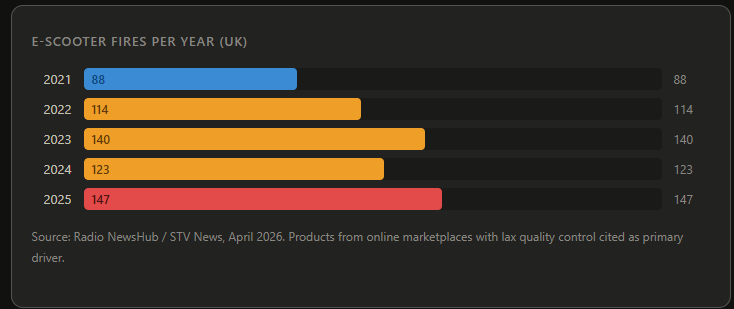
In 2025, there were 147 recorded e-scooter fires in the UK alone. That is a 20 percent increase from 123 fires in 2024 and a staggering jump from just 88 fires in 2021.
E-bike fires, which share the same root causes, rose 38 percent in the same year to reach a record high.
The link between online marketplace purchases and fire risk has been documented repeatedly. Nick Bailey of BatteryIQ, a company that monitors e-bike battery safety, has stated plainly that the products involved in fires are always cut-price products sold through online marketplaces with lax quality control.
The UK government has also taken action. In February 2026, a product safety report flagged a counterfeit electric scooter charger sold via Amazon that presented a serious fire risk because its plug did not meet electrical safety standards and had no fuse. The listing was removed, but the chargers were already in consumers’ homes.
A fire killed two siblings at a Queens home in New York after investigators discovered a charred electric scooter with a fake safety certification label. Salvatore Ingrassia, Port Director for JFK Airport, has said his agency receives hundreds of reports of houses burning down due to counterfeit electronics of this type. (CBS News, 2023)
Fake safety certifications are now the subject of federal lawsuits
In January 2026, Amazon and UL jointly filed suit in federal court against multiple e-bike and e-scooter sellers who allegedly placed false UL safety certification marks on their products.
The defendants include multiple Chinese manufacturers who were advertising products with UL logos in 2024 and 2025 without any authorization to do so.
UL certification is the standard consumers are supposed to rely on to verify that a product has been tested for electrical safety.
When that mark is counterfeited, buyers have no meaningful way to know whether the product they are looking at has ever been tested at all. The lawsuit is significant not just for what it reveals about individual bad actors, but for what it suggests about the scale of the problem.
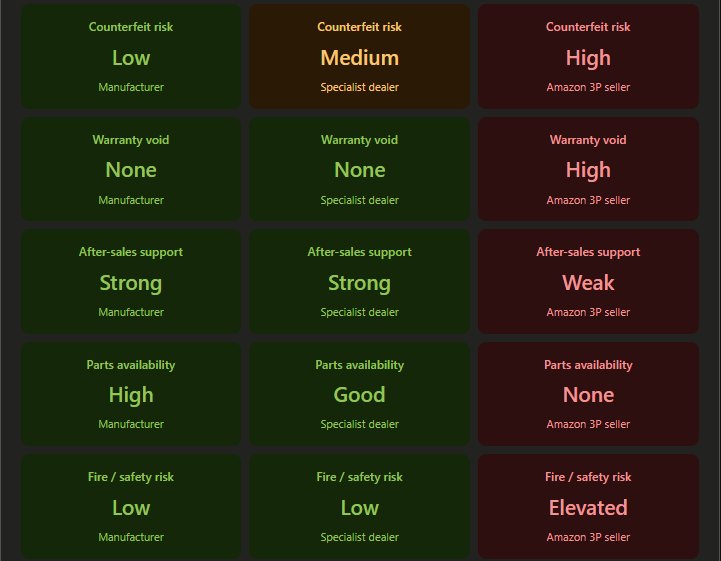
Risk comparison: where you buy vs what can go wrong
The grey market problem: your warranty may already be void
Many electric scooter brands do not authorize their products to be sold on Amazon at all. When a third-party seller lists one of these scooters on the platform anyway, they are operating in what is legally known as the grey market. The product may be genuine, but the purchase channel is unauthorized.
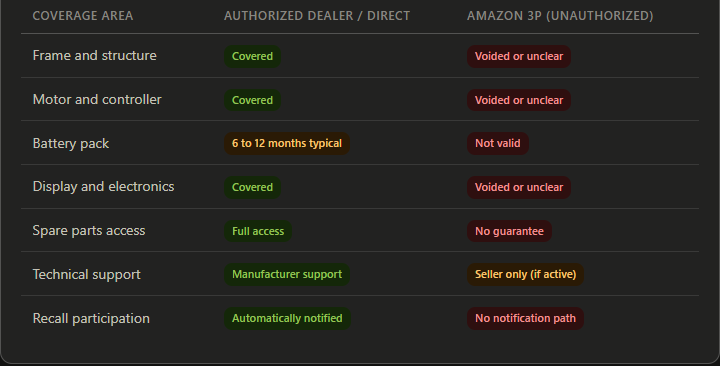
This matters enormously for warranty coverage. Many manufacturers have adopted warranty terms that are expressly voided by purchase from unauthorized dealers.
In legal terms, goods sold by unauthorized dealers are considered materially different from authorized versions because they lack the manufacturer’s warranty and support. Courts have upheld this reasoning as a valid basis for trademark infringement claims.
A discussion on Amazon’s own Seller Central forums includes a manufacturer reporting: “Amazon.ca is selling a grey market version of our product. They are not authorized dealers.”
The forum response was clear: products sold without authorization cannot carry the manufacturer’s full warranty, meaning customers who buy them are unaware they are getting a product that may be entirely unprotected. (Amazon Seller Central forums)
Even when a scooter listed on Amazon is genuine and sold with stated warranty terms, the claims process is typically routed through the third-party seller rather than the manufacturer. When that seller disappears, which happens frequently, the warranty disappears with them.
Warranty coverage: authorized vs unauthorized purchase channel
Amazon cannot always guarantee what you are getting
Amazon’s fulfilment model, particularly the Fulfilled by Amazon program, has a well-documented problem with co-mingling.
Under this system, identical products from multiple sellers are stored together in Amazon’s warehouses.
When you order what looks like a genuine product from a reputable seller, you may receive a unit that was actually supplied by a completely different seller, including one selling counterfeits.
The US Consumer Product Safety Commission found Amazon responsible under federal safety law for hazardous products sold by third-party sellers through this program.
Amazon had argued it bore no responsibility as a marketplace rather than a retailer. The CPSC disagreed, and Amazon was required to submit plans to notify consumers and remove hazardous products. Amazon did not contest that the products in question presented a substantial product hazard.
For electric scooters specifically, this creates a structural risk that has nothing to do with whether your specific intended seller is trustworthy. You cannot guarantee which unit you will receive.
Also Read: There are currently lots of complaints by Amazon Prime Members
Buying experience compared
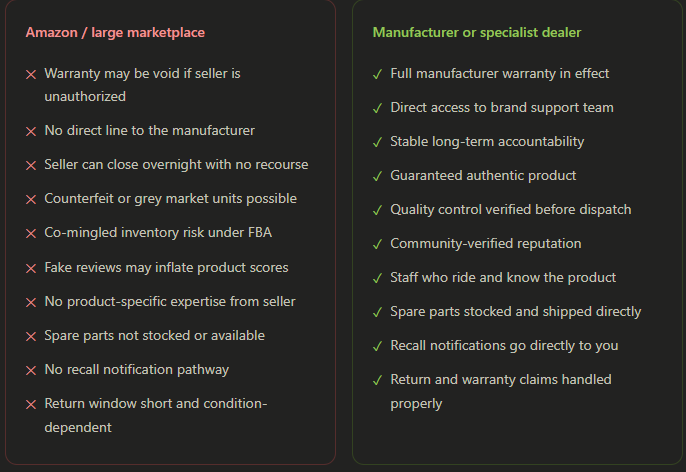
The fake review problem makes it worse
Nearly seven in ten consumers were misled into purchasing counterfeit or misrepresented items online at least once in a single year, according to a 2023 study from Michigan State University.
Amazon’s review system, while broadly useful, is particularly vulnerable to manipulation in high-margin product categories like electric vehicles.
Third-party sellers on Amazon have been documented closing down and reopening under new names after collecting payment, resetting their review history in the process.
Review farms have also been used to inflate five-star counts on products in short windows, a pattern that online tools like Fakespot were built specifically to detect. The electric scooter category, with its large number of relatively unknown Chinese brands, is especially prone to this dynamic.
Red flags when reviewing an Amazon electric scooter listing
- Reviews cluster at 5 stars with similar wording
A genuine product builds reviews gradually across a range of scores. A burst of identical-sounding 5-star reviews in a short window is a documented indicator of paid reviews.
2. Seller name does not match the brand name
Legitimate manufacturers and their authorized dealers typically sell under a consistent name. A seller name that looks random or generic is a warning sign.
3. Price is significantly below the brand’s own storefront
Performance electric scooters have real manufacturing costs. A listing that undercuts the official price by 20 percent or more usually means something is wrong: it is older stock, a counterfeit, or a grey market unit.
4. Model appears discontinued on the brand’s own site
Amazon listings often persist for discontinued models. Buying outdated stock means parts will be harder to source and the seller has no incentive to maintain support.
5. No physical address or warranty terms for the seller
A legitimate seller with a real business backing a high-value product will have traceable contact information and published warranty terms. Absence of either is a serious warning.
What the community has seen firsthand
The advice that electric scooter enthusiasts give to new riders is not theoretical. It comes from watching specific scenarios play out repeatedly. These are the most common stories:
The warranty claim that goes nowhere. A rider buys a dual-motor scooter on Amazon. A motor fails at three months. They contact the seller for a warranty claim. The seller asks them to ship the scooter back at their own expense. The seller then disputes that the fault is covered. The claim drags on for weeks, often ending with the rider out of pocket for both the repair and the shipping.
The spare part that does not exist. An Amazon-purchased scooter needs a replacement battery, controller, or display. The seller has no parts. The brand does not recognize the unit as a legitimate purchase. Generic replacements either do not fit or are not compatible with the scooter’s BMS. The scooter becomes a doorstop.
The seller that has vanished. A rider goes back to the Amazon listing months after purchase and finds it no longer exists. The seller account is gone. Any warranty claim, any parts request, any communication is now impossible. The scooter is on its own.
The charger that catches fire. A budget scooter bought through Amazon ships with a charger that looks legitimate but has no genuine safety certification. The charger fails, usually while the scooter is charging overnight. In the worst documented cases, this has caused house fires.
Where experienced riders recommend buying
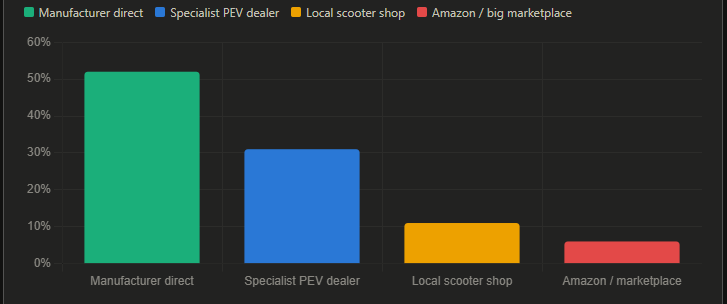
What makes a specialist dealer different
When the community says buy from a dealer, they do not mean any online retailer. They mean specialist personal electric vehicle (PEV) dealers who carry a curated range of brands, stock their own parts, and have staff with genuine product knowledge.
The difference from Amazon is not just about warranty documentation. It is about the relationship. A good PEV dealer will know which firmware version your scooter is running, whether there has been a production batch issue with a specific component, and how to get parts to you quickly.
When the YUME X11+ community spotted the quick-disconnect motor upgrade in the current production batch, it was the kind of detail that circulates through dealer networks before it ever appears on a product page.
Dealers like Kaabo USA, Voro Motors, and Urban Machina exist specifically because the electric scooter market needs an intermediary layer between manufacturers (many of whom are based in China) and consumers who need local support.
They absorb the complexity of international shipping, customs, and brand communication so that the end buyer has a clear single point of contact for everything after purchase.
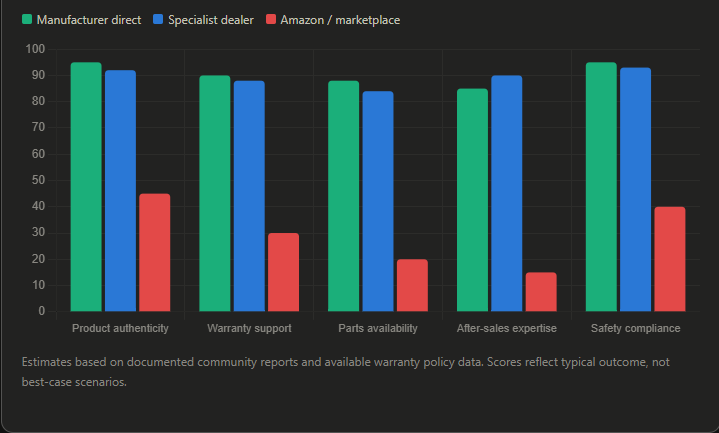
Customer experience score by purchase channel (estimated)
The CPSC has made Amazon legally responsible
For a long time, Amazon argued that it was a marketplace and not a retailer, and therefore bore no legal responsibility for products that third-party sellers listed on its platform.
The US Consumer Product Safety Commission rejected that argument in a formal ruling, finding Amazon responsible under the Consumer Product Safety Act for hazardous products sold by third-party sellers through the Fulfilled by Amazon program.
This is a meaningful development for consumer awareness, but it does not change the practical experience of a buyer trying to resolve a problem with a dangerous or defective electric scooter.
The legal accountability exists in principle. In practice, getting a resolution through Amazon’s dispute processes remains significantly harder than working directly with a manufacturer or established dealer who has a direct incentive to keep your business and protect their reputation.
The CPSC ruling means Amazon can be held accountable in regulatory proceedings. But for individual buyers, the gap between legal accountability and practical customer service remains wide. The easiest path to a resolved warranty claim is still buying from a channel where the seller genuinely needs your future business.
How to find the right place to buy
The electric scooter community has developed a fairly consistent set of criteria for evaluating where to buy. Here is the checklist that experienced riders apply:
- Check if the brand lists authorized dealers on its website
Most reputable manufacturers maintain a published list of authorized dealers. If the storefront you are considering is not on that list, proceed with caution regardless of how legitimate the listing looks.
2. Search the brand name plus the dealer name in community forums
Reddit’s r/ElectricScooters and brand-specific Facebook groups will almost always have threads discussing dealer experiences. A reputable dealer will have visible, positive history. The absence of any mentions is itself a flag.
3. Confirm the warranty terms are from the manufacturer, not just the seller
Read the warranty documentation carefully. A seller-backed warranty has no value if the seller closes. You want warranty coverage that is backed by the manufacturer and honored regardless of which channel you bought from.
4. Ask about spare parts availability before you buy
A serious dealer will be able to tell you which parts they stock, which they can order, and typical lead times. If they cannot answer this question, they will not be able to support you after purchase either.
5. Compare the price against the manufacturer’s own storefront
A legitimate dealer selling at a fair margin will be within a reasonable range of the manufacturer’s retail price. Significant discounts are almost always explained by something you do not want: older stock, grey market sourcing, or a counterfeit product.
6. For high-performance scooters, buy from the manufacturer’s official regional storefront
Brands like YUME, Kaabo, Apollo, and Gspace operate official regional storefronts for North America, Canada, Europe, and other markets. These storefronts are the gold standard for warranty coverage, customer support, and pricing. There is no good reason to go elsewhere for a scooter in this tier.
The community is not anti-Amazon in general
It is worth being clear about what the community advice is and is not saying. Nobody in the electric scooter world is suggesting that Amazon is a bad place to buy a phone case or a charging cable.
The concern is specific to high-value, safety-critical personal electric vehicles where the stakes of a bad purchase are high and the value of a long-term support relationship is real.
There are also some brands that do sell through Amazon and maintain a legitimate authorized presence on the platform, with genuine warranty support accessible through the brand itself.
The rule is not a blanket ban on Amazon listings. The rule is: if you cannot verify that the seller is authorized by the manufacturer, that the warranty is backed by the manufacturer, and that the product is exactly what it claims to be, then you are taking on risks that an experienced rider would not take on for a vehicle that can reach 50 miles per hour and that you will be charging in your home overnight.
The community’s consistent recommendation to buy direct from manufacturers or trusted specialist dealers is built on exactly those considerations. It is not about brand loyalty or snobbery. It is about having someone in your corner when something goes wrong, and in the electric scooter world, something eventually always does.
The short version: for any electric scooter above $500 that you intend to ride regularly, buy from the manufacturer’s official storefront or an authorized specialist dealer who is active in the community. The slightly higher friction of going direct is worth every bit of it when you need a warranty claim honored, a spare part shipped, or a firmware issue resolved.
About the Author
Amos is the founder and lead writer at SaasMoment.com, a dedicated resource for electric scooter enthusiasts, commuters, and buyers seeking practical, real-world insights. With over 6 Years of hands-on experience riding, testing, and reviewing dozens of electric scooters across urban, suburban, and off-road conditions, Amos brings firsthand knowledge of performance, battery life, build quality, safety features, and everyday usability